Category: Uncategorized

  • Ohio’s Senate Race Is a Candidate Quality Test. Neither Side Can Coast.

    A Margins Razor’s Edge race

    Oct 6, 2026 · @Lance Lunsford

    Democrats could not have asked for a better candidate in Ohio than Sherrod Brown, and Republicans could not have asked for a better state. That is why the special election for Vice President JD Vance’s old senate seat is one of the closest races on the board, four weeks out.

    The national argument this fall is about two things at once: a president with weak approval numbers, and a Democratic bench that critics say isn’t strong enough to cash in on it. Those two arguments collide in Ohio. Brown is the Democrats’ best-case candidate, running in a climate that should favor him, against an appointed Republican with name recognition still catching up. If Democrats can’t grow their margin here, it says a lot about the rest of the map.

    The matchup

    This is a special election. Vice President JD Vance resigned the seat on Jan. 10, 2025, and Gov. Mike DeWine appointed his lieutenant governor, Jon Husted, a week later. Voters decide on Nov. 3 who serves the rest of Vance’s term.

    Jon Husted (R)Sherrod Brown (D)
    Current roleAppointed U.S. senator since Jan. 2025Former three-term U.S. senator
    Last statewide raceWon lieutenant governor, 2022Lost to Bernie Moreno by about 3.5 points, 2024
    May 2026 primaryUnopposed, 736,413 votes89.4% against Ron Kincaid
    Raised through June 30$14.4 million$38.6 million
    Cash on hand, June 30$9.4 million$16.2 million

    Libertarian Bill Redpath and independent Greg Levy are also on the ballot. In a race this close, a point or two to third parties can decide the margin.

    Candidate quality: the case for each side

    “Candidate quality” is usually something people say after a race is lost. In Ohio it is the whole race, because both parties got roughly the candidate they wanted.

    Why Brown is the Democrats’ best shot. He won statewide three times in a state that has moved steadily right. His brand, a rumpled, pro-labor populist who talks about trade and paychecks, is built for the voters Democrats have lost in the industrial Midwest. He has also outraised Husted by more than two to one. In an August Fox News poll, he drew 11% of Republicans and 25% of Republicans who don’t identify with MAGA, plus about two-thirds of independents. His favorability was 51% favorable to 47% unfavorable.

    Brown’s problem. He has run this exact race before and lost. In September 2024, Brown led Bernie Moreno by about two points in the polls and lost by about 3.5. Republicans will remind every voter that Ohio already chose someone else, and any Ohio poll showing Brown ahead now carries an asterisk.

    Why Husted can win. Ohio voted for Donald Trump by 11 points in 2024. Husted has Trump’s endorsement, the title of senator, and a decade of statewide name recognition as secretary of state and lieutenant governor. He didn’t face a primary, so he enters the fall without bruises from his own side.

    Husted’s problem. Two things weigh on him. The first is the FirstEnergy bribery scandal: in August, environmental groups launched a $9 million ad campaign arguing that the scandal “happened on Jon Husted’s watch” and tying him to higher utility bills, and Brown has made the same case. The second is proximity to Trump: 51% of voters in the Fox News poll said they were concerned Husted is too close to the president, compared with 44% who worried Brown is too tied to the Democratic establishment. Husted was 10 points underwater in that poll, at 43% favorable and 53% unfavorable.

    The result is a race where each candidate is about as strong as his party could hope for, and each carries a weakness the other side can’t stop talking about.

    Two readings of the same map

    On the same day, October 3, two veteran observers looked at the Senate and came to opposite conclusions. Ohio sits right between them.

    Mark Penn: the climate isn’t enough. On Fox News’s Hannity, the former Clinton pollster said he expects Republicans to hold the Senate, largely because “Democrats have incredibly weak candidates in Maine and Michigan.” He called this “the most unpredictable” cycle, with “polls here are neck and neck virtually everywhere,” and said turnout and attitudes toward the economy will decide it.

    Penn’s point applies to Ohio in reverse. Ohio is the one place Democrats can’t blame the candidate. They recruited the strongest Democrat in the state, in a year when, by the Fox News poll, 56% of Ohioans view Trump unfavorably. Yet the polling averages give Brown a lead of roughly three to five points. That is barely more than the two-point lead he held at this stage in 2024 before losing. If an unpopular president and a top-tier candidate only move the needle that far, Penn’s broader argument holds: the national mood alone doesn’t deliver seats.

    David Brooks: this is how upsets happen. On PBS NewsHour, the New York Times columnist said it looks like the Senate will go to Democrats. His reason is the president’s standing: “When you’re at 38, where Trump is right now, that’s just historically bad for a midterm.” His sharpest line: “This is the kind of climate where people you don’t think will lose, lose.” His example was Kansas, where he said a Democrat could win the governor’s race.

    Brooks’s view describes Husted’s risk exactly. Husted is an appointed incumbent in an 11-point Trump state, the kind of Republican nobody expected to sweat. If the climate Brooks describes is real, Ohio is where it shows up first.

    Both arguments can be true at once. Democrats may be underperforming the environment in Ohio and still win, because the environment is that bad for the party in power. Which effect is bigger is the question the margin will answer.

    What the numbers say

    Brown leads in the recent public polls, but rarely by much, and the trend tells the story of the race.

    PollField datesBrownHustedMargin
    TrafalgarSept. 14-16, 202645%42%Brown +3
    InsiderAdvantageSept. 8-9, 202647%42%Brown +5
    Bowling Green State / YouGovSept. 1-10, 202648%45%Brown +3
    Fox NewsAug. 6-10, 202653%45%Brown +8
    Emerson CollegeAug. 18-19, 202544%50%Husted +6

    A year ago, Husted led by six. Brown has since moved ahead, with the September polls clustering around a three-point lead. Prediction markets lean the same way: on Kalshi in late September, Brown traded at about 61 cents to Husted’s 39.

    Two cautions apply. Ohio polls overstated Brown in 2024 by roughly five and a half points (a two-point lead that became a 3.5-point loss). And inflation is the top issue for 40% of Ohio voters, according to Fox News. Those voters could break late toward whichever candidate they trust more on prices. A three-point lead with that history is a lead in name only.

    Make your call

    Ohio is on the Margins board as a Razor’s Edge race: the closest races on the board, where every point of margin matters.

    Picking a winner is the easy part. The real question is by how much. Do you think Penn is right, and Brown’s lead fades the way it did in 2024? Do you think Brooks is right, and this is the year an appointed incumbent in a Trump state goes down? Or do you think it’s closer than either of them expects?

    Set your margin at marginspro.com. Picks are scored on the certified result, and the longer you hold your call, the more it’s worth.

    Margins is a free, nonpartisan election prediction game. We don’t show other players’ picks until you’ve made your own.

    Sources

  • Michigan’s Senate Race Is a Referendum. The Question Is on Whom.

    Sep. 21, 2026 · Lance Lunsford

    The closest Senate race in the country turns on one question: will an angry Democratic base show up against President Trump when it doesn’t much like its own party?

    Michigan’s open Senate seat, vacated by retiring Democrat Gary Peters, is a genuine coin flip. Democrat Abdul El-Sayed leads Republican Mike Rogers in most September polls, but only one gives him more than a margin-of-error edge.

    PollField datesSampleEl-Sayed (D)Rogers (R)Margin
    Suffolk UniversitySept. 21500 LV, ±4.4——El-Sayed +7
    Emerson CollegeSept. 12–141,000 LV, ±3.048%46%El-Sayed +2
    Washington Post–Schar SchoolSept. 10–14803 LV, ±3.948%45%El-Sayed +3
    Glengariff GroupAug. 31–Sept. 3600 LV, ±4.044.4%45.8%Rogers +1.4

    Cook, Sabato’s Crystal Ball, and Inside Elections all rate it a Tossup. Schumer-aligned Senate Majority PAC has put $30 million into the state. The GOP’s Senate Leadership Fund has committed $51 million, and a MAGA-aligned super PAC plans another $18 million.

    El-Sayed says “All pathways to a Senate majority run through Michigan.” Chuck Schumer is hedging, however, to recognize the critical time to win over voters and convince them in other states that his party has solutions: “A path… clearly goes through Michigan, but we have a whole bunch of different paths,” Schumer said.

    The national environment certainly seems to favor Democrats. Yet, Michigan is close anyway. That gap highlights a deeper story both sides seem hesitant to explore deeply, reaching instead for superficial grab bag of over-simplified political talking points that make memes and two-frame gifs look like complex political rubrics.

    Referendum #1: Donald Trump

    Midterms usually become a vote on the sitting president, and Michigan fits that pattern in three ways.

    1. Trump is underwater in a state he won. Trump carried Michigan in 2024. Emerson now puts his approval there at 40% approve, 55% disapprove. Nationally, Marquette Law School has him at 37/63, with strong approval down to 15% from 29% in February 2025.

    2. Rogers tests Trump’s coalition without Trump on the ballot. In 2024, Rogers lost to Elissa Slotkin by 19,006 votes, about a third of a point, even as Trump carried the state. The question for 2026 is whether Trump’s voters come out for Rogers when Trump isn’t on the ballot. Suffolk’s poll suggests a warning sign: independents favor El-Sayed 51–35.

    3. The economy now belongs to Trump. Emerson found 47% of Michigan voters rank the economy first in priorities, far ahead of health care at 13%. Suffolk director David Paleologos says dissatisfaction with tariffs and data centers “caused a massive shift to Democratic candidates among independents.” In an automotive state, every price complaint might reveal itself as a verdict on the White House.

    Referendums #2 and #3: The Democratic establishment, and the candidate himself

    The party establishment. El-Sayed beat Rep. Haley Stevens, the establishment favorite, by less than a point in August: 48.5% to 47.6%. More than 1.2 million people voted in that Democratic primary, up from about 933,000 in 2024, per Bridge Michigan. El-Sayed took more than 60% in Kent and Washtenaw counties. Stevens swept metro Detroit and won more than 60% in Detroit itself.

    El-Sayed has stayed noncommittal about backing Schumer as Democratic leader — another telling feature of emerging candidates and the intensifying purity tests applied in several state primary races. If he wins, a progressive who owes party leadership very little goes to the Senate with chips to cash in for voters but potential for relationship struggles if established leaders are at the helm. If he loses, the establishment will say it warned everyone.

    The candidate. The Washington Post–Schar poll finds El-Sayed running behind the environment his party is enjoying. It reports that more than 4 in 10 likely Michigan voters say they would not support a Muslim candidate for president, and that those attitudes go along with lower support for El-Sayed. There is also an education divide. Emerson has voters without a four-year degree favoring Rogers 48–45, while college graduates favor El-Sayed 53–42.

    Independent TJ Stephens is also on the ballot. Suffolk measured minor candidates at 3% combined, which is enough to play a notable role in a race this close.

    The Democrats’ mobilization problem

    Rogers’s best path is Democratic voters who are fed up with their own party. The data shows that frustration clearly, and it has lasted for months.

    • Now: Only 36% of Democrats approve of how Democrats in Congress are handling their job, and 64% disapprove (Marquette Law School, Sept. 2–9, 2026).
    • The slide began earlier: Democrats’ favorable view of their own congressional members fell from 85% in November 2024 to 63% in January 2026 (Economist/YouGov). YouGov noted that net favorability “has fallen to +30 from +51 over the past month.”
    • The quote that sums it up: When Quinnipiac found congressional Democrats at a record-low 18% approval in December 2025, analyst Tim Malloy said: “Democratic voters want their party to hold the reins of the House but are not the least bit happy about what they are doing at the moment.”

    What matters on Election Day. Unhappy voters rarely switch parties. They stay home, and Michigan is decided by thin margins. The Washington Post–Schar poll shows where the risk is: 83% of likely Black voters want Democrats to control the Senate, but only 67% back El-Sayed. Detroit went for Stevens by more than 60% in August. If El-Sayed can’t close that 16-point gap in Wayne County, the national environment may not be enough to carry him.

    The case against the worry. Marquette finds 47% of Democrats “very enthusiastic” about voting, compared with 32% of Republicans, and Democrats lead the national generic ballot among likely voters 54–41. In the primary, El-Sayed won 59% of Election Day voters in Wayne, Oakland and Macomb, which suggests he can bring out new voters. Being angry at your party and skipping the election are two different things.

    The bottom line

    Michigan will measure which is stronger in 2026: anger at Trump, or Democrats’ frustration with their own party. If anger at Trump wins, El-Sayed wins, and Democrats have a real path to the Senate majority. If frustration keeps enough Democrats home in Detroit, Rogers wins the seat he missed by 19,006 votes two years ago.

    Is Michigan voting on Trump, or on the Democrats?

    Trump is underwater in Michigan, at 40% approve and 55% disapprove, and Democrats lead the national generic ballot by double digits. Even so, Abdul El-Sayed vs. Mike Rogers is a coin flip.

    The reason is that Democratic voters aren’t happy with their own party. Only 36% approve of how congressional Democrats are doing their job. And in Detroit, which went heavily for Haley Stevens in the August primary, El-Sayed still has ground to make up.


    Now, what do you think? 👇

    What’s your margin? Pick the Michigan Senate race on MarginsPro, set your slider, and lock it in. The points go to players who get the winner right and call the margin closely.

    Make your pick: who wins, and by how much?

  • The undecidedly undecides have it

    Or … The I-Don’t-Knows have it.

    Can U.S. Sen. Susan Collins again outrun yet another democratic challenges in Maine? Like Texas and a handful of other Senate races, the race is in the hands of undecided voters.

    But unlike Texas where the promise from the Left of a looming blue wave has ebbed every election since Tony Sanchez’s expensive sinking in 2004 against Gov. Rick Perry, Collins routinely outmaneuvers challengers election-after-election … and doing so following brutal beatings from the Right for moderate positions that do just enough to keep the favor of swing voters.

    There’s plenty up for grabs. The undecided voters making races look tight could break either way as Maine takes a look at whether Republicans in power for the remainder of President Donald Trump’s term is a good idea.

    Source: DecisionDeskHQ

    Standing by while her original Democratic challenger rapidly rose on an everyman message, Graham Platner collapsed in an epic meltdown after accusations pulled him under water enough for him to call it quits. It might portend well for Collins who frequently pulls things out even when her races look too formidable to win. Take, for example, her last run when her challenger in 2020 led by several points going into Election Day. Still, Collins emerged victorious handily.

    “This pattern of running ahead of her party’s brand has defined Collins’s career in blue-leaning Maine. Collins has even won three times in White House years when her party lost Maine by 9+ points.”
    – Decision Desk HQ

    The available undecided voters in Maine reveal plenty of room for either candidate, but in recent weeks, polling is breaking her way with gains while Democratic rival Troy Jackson slips a few points. If the trend holds, Collins has more than enough time to achieve a sizable win.


    Make your pick


    Nationally, the sentiment is positive for Democrats, but as The Washington Post’s Margin of Victory column by Henry Olsen highlights, the rosy feelings resonating throughout the country on the Left, paint an opaque portrait.

    YouGov, for example, is a well-regarded pollster, but it systematically overestimated the share of Democrats in the 2024 electorate, causing it to predict that Kamala Harris would win the popular vote by three percentage points and putting her ahead in five of the seven swing states. Famously, neither of those predictions came true.

    • Henry Olsen/ The Washington Post

    He even highlights the trouble with polling accuracy in the Maine race where one pollster had Collins ahead by one point among all surveyed voters while with likely voters, Jackson was ahead by nine points. Certainly, there’s details in the details, and the cross-tabs have to be examined carefully.

    One area can prove itself to be worth betting on — excitement and unity behind a candidate. As Olsen highlights, the density of excitement around a candidate, or a lack thereof, speaks to turnout. Democrats appear to be much more united around their candidate by comparison in places like Texas.

    Five recent polls of the Texas Senate race that include cross tabulations by party put the scandal-plagued state attorney general’s support among Republicans at 84 percent on average, while James Talarico, his Democratic opponent, enjoys 93 percent support from Democrats. 

    • Henry Olsen/ The Washington Post

    If that’s the case, and assuming Talarico can reinvigorate the detractors from the democratic primary and keep momentum around his base to turnout on Election Day, he will only have a handful of undecided voters and independent voters to motivate at the ballot box. It might be enough to white-knuckle his way through a storm as Paxton acolytes, fearing the worst, continue making as much as they can out of his statements on gender. Surprises are to come, certainly, this October, and as the waves come crashing against the hull of each candidate’s ship, their survival will depend on their authentic appeal to those who look closer at this year’s ballot than they have in a long, long time.

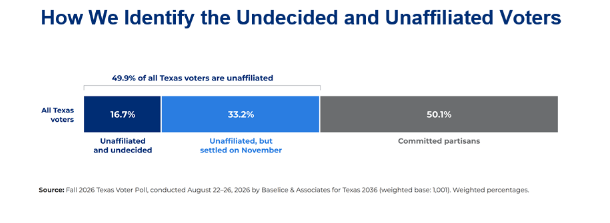
    That population of undecided voters might be bigger than expected … even in Texas. According to Texas 2036, a non-partisan think tank based in Austin, Texas polling indicates a large chunk of undecided voters who are unaffiliated by party. With half of the electorate committed as partisans, another 33% are settled on the November election decision but don’t identify with either party (in case you were wondering how populism works). That remaining 16.7 percent claim neither party and are still yet to decide on their ballots.

    Among these voters (the 16.7% percent), 38% expect to support a mix of candidates across parties, another 24% are unsure how they will vote, and only about one in seven currently plans to vote exclusively for one party.

    • Texas 2036 Newsletter

    So if you were hoping for a fall season of live sports without annoying partisan ads supported by PACs with fancy sounding Orwellian names, sorry to say, that 16.7% is an alluring target population despite the likelihood that what moves them is less fire and brimstone than what will hit the airwaves. That’s also because that 50.1% who say they are already decided still have one major thing to decide on: Going to the polls to cast that ballot.

  • Texas Race for U.S. Senate Tightens in Race for Undecided Votes

    The race to replace U.S. Sen. John Cornyn, R-Texas, after a brutal primary runoff loss to sitting Texas Attorney General Ken Paxton, lacks the slugging and swinging, but traditional mud-slinging figures in as Paxton and his democrat opponent, State Rep. James Talarico, HD-50, battle for undecided votes.

    The unusually close race in a state that hasn’t elected a Democrat for statewide office since Republicans began snatching them up handily in 1994. While Paxton brushes off alleged scandal after alleged scandal with seeming ease, the weight of more than a decade of issues, is now coming down to General Election voters considering the records of both candidates.

    The narrow polling says less about the candidates than it does the nature of Republican voters in Texas. Those who follow the Texas House closely have seen firsthand why Talarico is getting a second look from Republican voters. For years, his performance in committee hearings and the back microphone of the Texas House of Representatives features a messenger whose rallying cry appeals more for its whisper than for a brawny volume. Instead, Talarico features a collection of YouTube hits where he calmly untangles testimony in hearings considering legislation over things like displaying the Ten Commandments in public schools. His approach has generated attention from podcasting comedian Joe Rogan, himself branded right or not as a conservative leaning foe of the progressive left. “[You] need to run for president. We need someone who’s actually a good person,” Rogan told Talarico in his 2025 interview.

    Still, it’s only enough to generate a threat. And Talarico has yet to land a final blow. Nor has Paxton revealed enough to do himself in for a final count — despite an attempt to impeach him by fellow Republicans in his own Legislature over a list of offending issues.

    For everyday voters, considering the array of information and blistering digital ads, there still appears to be room for Paxton to take the lead heading into Election Day. Although he has a slight edge, according to most polling, a large segment of undecided voters have yet to commit to either.

    Despite his moderate everyman pitch, Talarico’s true progressive beliefs keep surfacing, slowly shifting voter sentiment and leaving Texans wondering what he actually believes.” USA Today | Nicole Russell

    UPDATE YOUR PICK

  • Georgia Isn’t Just a Senate Race

    It’s a Test of Both Parties’ Coalitions.

    Few races in 2026 will provide a clearer reading of the American electorate than Georgia’s contest between Democratic Sen. Jon Ossoff and Republican Rep. Mike Collins.

    Georgia has become one of America’s defining swing states. Donald Trump carried it in 2016, Joe Biden narrowly flipped it in 2020, and Trump reclaimed it in 2024. Yet Democrats have won both of the state’s U.S. Senate seats during that period. That makes Georgia less a reliably red or blue state than a test of which party can assemble the right coalition when Trump himself isn’t on the ballot.

    And that makes losing here potentially more instructive than winning.

    If Republicans Lose

    A Collins defeat would raise an uncomfortable question for Republicans: Can the Trump coalition reliably transfer to other Republican candidates when Trump isn’t on the ballot?

    Collins won the Republican nomination as a strong Trump ally and has emphasized immigration, crime, cultural issues and support for much of Trump’s agenda. But the general electorate is broader than the Republican primary electorate. Recent polling has shown Ossoff performing particularly well among independents, while Collins has faced questions about whether his close identification with Trump limits his appeal beyond the GOP base.

    That distinction would matter nationally. Republicans don’t necessarily need to abandon Trump or his policies to interpret a Georgia loss as evidence that candidate style and coalition-building matter. The question would instead become whether the party needs nominees who can retain Trump voters while performing better with suburban, independent and less ideologically committed voters.

    Georgia would make that question difficult to dismiss because Trump himself won the state just two years earlier.

    A Republican loss could therefore suggest that Trump’s electoral coalition and the Republican Party’s electoral coalition are not perfectly interchangeable.

    If Democrats Lose

    For Democrats, the lesson would be different—and potentially just as significant.

    Ossoff has money, incumbency and unusually high national visibility. Rather than running away from confrontation with Trump, he has increasingly made opposition to the president central to his campaign. At the same time, he has attempted to retain crossover appeal through issues such as affordability, healthcare, infrastructure and government accountability.

    If Democrats cannot hold Georgia under those circumstances, it would raise questions about the ceiling of the coalition that produced their breakthrough victories there in 2020 and 2021.

    Democrats would have to ask whether anti-Trump sentiment plus strong turnout among metropolitan Atlanta, Black and younger voters is sufficient in a midterm—or whether the party still needs substantially greater support among working-class and less urban voters to build durable majorities in closely divided states.

    More immediately, losing Georgia would make the mathematics of taking the Senate considerably harder. Republicans currently hold a 53-47 advantage, meaning Democrats need a net gain of four seats for outright control. Georgia is a Democratic-held seat; losing it would effectively increase the number of Republican seats Democrats need to capture elsewhere.

    Why Georgia Matters Beyond Georgia

    The most interesting possibility is that Georgia answers two different questions simultaneously.

    For Republicans: Can a candidate built to win the Trump-era Republican primary electorate also reconstruct Trump’s general-election coalition without Trump?

    For Democrats: Can the coalition that turned Georgia competitive survive even when the presidency—and Trump himself — aren’t on the ballot?

    That makes Georgia more than another seat in the arithmetic of Senate control. It is one of the best tests in 2026 of whether the political coalitions created during the Trump era are becoming permanent — or prove to be a unique place in time to be undone by a new trendsetter disrupting an economy of personality whose grip on the GOP and media might endure or crumble.