Or … The I-Don’t-Knows have it.
Can U.S. Sen. Susan Collins again outrun yet another democratic challenges in Maine? Like Texas and a handful of other Senate races, the race is in the hands of undecided voters.
But unlike Texas where the promise from the Left of a looming blue wave has ebbed every election since Tony Sanchez’s expensive sinking in 2004 against Gov. Rick Perry, Collins routinely outmaneuvers challengers election-after-election … and doing so following brutal beatings from the Right for moderate positions that do just enough to keep the favor of swing voters.
There’s plenty up for grabs. The undecided voters making races look tight could break either way as Maine takes a look at whether Republicans in power for the remainder of President Donald Trump’s term is a good idea.

Standing by while her original Democratic challenger rapidly rose on an everyman message, Graham Platner collapsed in an epic meltdown after accusations pulled him under water enough for him to call it quits. It might portend well for Collins who frequently pulls things out even when her races look too formidable to win. Take, for example, her last run when her challenger in 2020 led by several points going into Election Day. Still, Collins emerged victorious handily.
“This pattern of running ahead of her party’s brand has defined Collins’s career in blue-leaning Maine. Collins has even won three times in White House years when her party lost Maine by 9+ points.”
– Decision Desk HQ
The available undecided voters in Maine reveal plenty of room for either candidate, but in recent weeks, polling is breaking her way with gains while Democratic rival Troy Jackson slips a few points. If the trend holds, Collins has more than enough time to achieve a sizable win.
Make your pick
Nationally, the sentiment is positive for Democrats, but as The Washington Post’s Margin of Victory column by Henry Olsen highlights, the rosy feelings resonating throughout the country on the Left, paint an opaque portrait.
YouGov, for example, is a well-regarded pollster, but it systematically overestimated the share of Democrats in the 2024 electorate, causing it to predict that Kamala Harris would win the popular vote by three percentage points and putting her ahead in five of the seven swing states. Famously, neither of those predictions came true.
- Henry Olsen/ The Washington Post
He even highlights the trouble with polling accuracy in the Maine race where one pollster had Collins ahead by one point among all surveyed voters while with likely voters, Jackson was ahead by nine points. Certainly, there’s details in the details, and the cross-tabs have to be examined carefully.
One area can prove itself to be worth betting on — excitement and unity behind a candidate. As Olsen highlights, the density of excitement around a candidate, or a lack thereof, speaks to turnout. Democrats appear to be much more united around their candidate by comparison in places like Texas.
Five recent polls of the Texas Senate race that include cross tabulations by party put the scandal-plagued state attorney general’s support among Republicans at 84 percent on average, while James Talarico, his Democratic opponent, enjoys 93 percent support from Democrats.
- Henry Olsen/ The Washington Post

If that’s the case, and assuming Talarico can reinvigorate the detractors from the democratic primary and keep momentum around his base to turnout on Election Day, he will only have a handful of undecided voters and independent voters to motivate at the ballot box. It might be enough to white-knuckle his way through a storm as Paxton acolytes, fearing the worst, continue making as much as they can out of his statements on gender. Surprises are to come, certainly, this October, and as the waves come crashing against the hull of each candidate’s ship, their survival will depend on their authentic appeal to those who look closer at this year’s ballot than they have in a long, long time.
That population of undecided voters might be bigger than expected … even in Texas. According to Texas 2036, a non-partisan think tank based in Austin, Texas polling indicates a large chunk of undecided voters who are unaffiliated by party. With half of the electorate committed as partisans, another 33% are settled on the November election decision but don’t identify with either party (in case you were wondering how populism works). That remaining 16.7 percent claim neither party and are still yet to decide on their ballots.
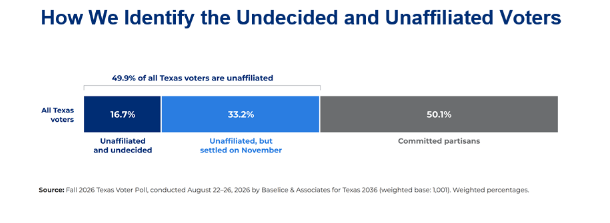
Among these voters (the 16.7% percent), 38% expect to support a mix of candidates across parties, another 24% are unsure how they will vote, and only about one in seven currently plans to vote exclusively for one party.
- Texas 2036 Newsletter
So if you were hoping for a fall season of live sports without annoying partisan ads supported by PACs with fancy sounding Orwellian names, sorry to say, that 16.7% is an alluring target population despite the likelihood that what moves them is less fire and brimstone than what will hit the airwaves. That’s also because that 50.1% who say they are already decided still have one major thing to decide on: Going to the polls to cast that ballot.